
Spray Safe, Spray Well: Reducing Pesticide Use Risks for Beginning Organic Growers and Spanish-Speaking Farmers
Project Director: Ethan Grundberg – Cornell Cooperative Extension
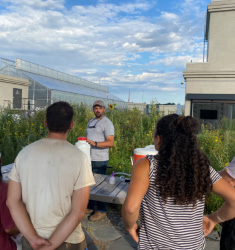
“Using the new nozzles and going through the whole calibration process has reduced the possibility that I would be wasting money on expensive product that I could be applying in a way that isn’t effective or efficient, helping me reduce the risk of wasted input cost.”
– Hudson Valley NY Farmer
Situation: The “Spray Safe, Spray Well” project team delivered a series of eight simultaneously interpreted webinars during the winter of 2021-22 designed to support beginning, organic, and Spanish-speaking vegetable farmers in reducing their risks associated with pesticide use. Over 100 individuals participated in at least one webinar, while 35 more completed the pesticide applicator license preparatory course resulting in four participants acquiring their applicator’s license. The team at Cornell Cooperative Extension led by Ethan Grundberg, worked individually with growers underserved by crop insurance over the summer of 2022 to provide tailored on-farm technical support to further reduce the production, legal, and financial risks associated with pesticide use. Specifically, growers were supported in developing and adopting Integrated Pest Management (IPM) strategies for the crops they were growing, calibrating spray equipment, trialing and evaluating new spray nozzle types to improve pesticide deposition and coverage, adjusting the pH of spray water using OMRI-listed citric acid buffers, and more. In-person meetings were also offered to a group of 9 vegetable farmers in Eastern New York’s “North Country” region focused on calibrating boom sprayers to improve pesticide efficacy and to a group of 11 urban farmers in Brooklyn, NY to discuss tips for reducing risks associated with backpack sprayers.
Outcomes: The combination of online education and individualized technical support allowed the project team to provide background information to program participants while uniquely supporting underserved growers in managing their risks related to pesticide application. The project helped organic and Spanish-speaking farmers manage legal, production, and financial risks by aiding with regulatory compliance, improving pesticide application efficacy, and reducing pesticide use through the adoption of more efficient nozzle types, sprayer calibration, and reinforcing principles of integrated pest management. These achievements are significant to these target demographics since pesticide safety education is often inaccessible or too focused on conventional practices for those audiences.
Impact: Many of the efforts to create bilingual spaces in agriculture in the Northeast have focused on interpreting English language presentations into Spanish, which can have the effect of making Spanish-dominant participants feel less directly engaged. By leveraging the connections made with native Spanish-speaking agricultural professionals in the region, almost half of the webinar content was presented in Spanish first and interpreted into English. A number of growers who participated in the webinar on nozzle selection reached out to the project team specifically to try new spray nozzles and evaluate the difference in pesticide coverage compared to their previous setup. This type of direct request provided a much higher chance of tangible impact on the grower’s operation compared to other farmers who expressed broader goals like “improving pest management.” Another example, an organic vegetable grower managing over 100 acres of production in New York’s Champlain Valley was motivated to participate in the program to try to improve his return on investment of OMRI-listed pesticides. By working with the project team, the grower was able to cut his typical gallons per acre spray solution application rate nearly in half by changing out all of his fogger cone nozzles on his two, 30-foot boom sprayers in favor of turbo twinjet nozzles equipped with no drip shutoff. As a result, the grower was able to cover more acreage with each spray tank, thereby saving money and increasing application efficiency which has reduced his legal risk associated with off-target and off-label application and reduced his overall pesticide cost per acre.